Research
Superluminal Lasers for Ultrasensitive Metrology
Superluminal lasers (SLLs) have garnered significant attention over the past decade due to their potential to revolutionize precision measurements and metrology. These lasers operate under conditions where the group velocity exceeds the speed of light in vacuum. In this regime, their spectral sensitivity to variations in ambient parameters is greatly enhanced, potentially improving by six orders of magnitude. This property makes SLLs highly attractive for advanced sensing applications. They are particularly suited for challenging tasks such as gravitational wave detection, dark matter searches, and navigation-grade rotation sensing.
Our research focuses on the interaction of coherent light with Rb atoms, aiming to demonstrate an ultrasensitive optical sensor. By placing a vapor cell of Rb atoms inside an optical cavity and applying external lasers, we induce Raman gain and engineer the dispersion relation to achieve group velocity exceeding the speed of light in a vacuum. The cavity and the generated gain form a laser with a unique characteristic known as superluminal lasing.

Frozen Light and High-Order Exceptional Points
[object Object]

Solid-State Cooling via Plasmonic Metasurfaces
Electroluminescent Cooling (ELC) represents a novel paradigm in solid-state thermal management, where heat is actively "pumped" out of a material through the emission of light. This is achieved using Quantum Well (QW) semiconductor devices that function as integrated, vibration-free micro-refrigerators—a technology with significant implications for cooling high-performance computer processors and sensitive detectors. However, the primary challenge in achieving ELC is the extremely high efficiency required; in standard semiconductors, most emitted light is trapped by Total Internal Reflection (TIR), leading to reabsorption and parasitic heating rather than cooling.

Optical Nano Rectennas—The new solar cell
Antenna + ultra-fast tunneling diode for direct optical-to-DC conversion.
Nano-rectennas are nanoscale devices that collect light and produce DC power. Building on the strong foundations of antenna theory, a rectenna is constructed from a carefully designed antenna and an integral diode rectifier. At submicrometer wavelengths, the antenna must have nanoscale features, and with frequencies over 200 THz, the diode must be extremely fast, a tunnel junction. Combining the two into fully functional, scalable, efficient devices is a challenge that has been taken up by many and has yet to be accomplished.

Thermal feedback in Brillouin Fiber Lasers
A passive feedback mechanism enabling self-stabilizing fiber lasers.
The main drawback of fiber lasers is their high sensitivity to fluctuation in the properties of their surroundings (temperature, pressure, vibration, etc.). Even a minuscule fluctuation in the ambient parameters can destabilize them. Consequently, complex techniques are often utilized to isolate and stabilize fiber lasers.
A new, passive feedback mechanism inherent to Brillouin fiber lasers (BFLs) was discovered and studied in our group. This mechanism, stemming from the interplay between thermal optical-length variations and the gain-line-induced frequency-dependent lasing power, triggers unexpected and counterintuitive phenomena such as self-frequency stabilization, multistability, and memory effects. The direct benefit of this feedback mechanism is that it allows for passive self-stabilization of fiber lasers with minimal means of isolation. This nonlinear process can be controlled and modified by engineering the gain lineshape, rendering BFLs highly attractive as a platform for studying nonlinear dynamics and providing novel tools for various possible applications.

White Light Cavities
Cavities whose phase condition is satisfied over a band of frequencies.
White Light Cavities (WLCs) are characterized by a resonance that fulfills the phase condition over a band of frequencies. This is in contrast to conventional cavities in which this condition is satisfied at discrete frequencies (known as the resonance frequencies). This non-conventional property can be obtained by inserting a dispersive element into the cavity while tailoring the parameters of the cavity and the element in a manner where the frequency-dependent phase accumulation of the empty cavity is cancelled out by the negative phase slope of the dispersive element. The utilization of this WLC phenomenon was suggested for various important applications in sensing and communication.

Ultra-Long Fiber Lasers for Secure Key Distribution
Classical-physics key exchange via matched Bragg mirrors on long fiber cavities.
Most modern encryption algorithms make use of a shared secret – the encryption key, known only to the legitimate parties. This encryption key is a number/sequence of bits of varying length that is used by the encryption algorithm to scramble the original content of the message in a way that only other bearers of a relevant key could unscramble. Once all parties have the relevant keys, they can start transferring secure messages back and forth; however, the longer the same key is being used, the higher the risks are that an ill-purposed individual might manage to “guess” the right key and gain access to the content of the encrypted messages. To reduce the chances of that ever happening, it’s necessary to generate and exchange encryption keys securely, for long distances and at the fastest possible rates. One of the most studied solutions to this is Quantum Key Distribution (QKD), which theoretically offers absolute security; however, its physical implementations require expensive equipment, which is often not completely secure, and its bit rate drops exponentially with the distance due to attenuation, making it impractical for distances in excess of 150km.

Radial Bragg Lasers
Photonic-crystal disk and ring cavities with engineered radial profiles.
Radial Bragg lasers (RBLs) are a class of photonic crystal cavities that utilize Bragg confinement in circular geometry to realize disk or ring cavities. The Bragg confinement mechanism allows great flexibility in engineering the radial mode profile. For example, it is possible to design a resonator in which the light is confined within a defect composed of low refractive index material or even air. By contrast, this would be impossible in the case of conventional, total-internal-reflection-based resonators. Such a configuration is useful for high-power surface-emitting lasers, sensing applications, optical gyroscopes, and more. The Bragg reflection concept allows one to tailor the reflector structure to a desired radial field profile and decouple between the modal volume (or cavity dimensions) and the radiation losses. Another unique property of RBLs is that, in contrast to conventional lasers, their tendency to lase in a single mode increases with their size.

3D Polymer Photonics
Soft-lithography patterning of 3D active and passive polymeric devices.
Polymeric materials have interesting optical and mechanical properties, making them an attractive choice for future photonic systems. In addition to low optical losses and material dispersion, polymers are simple to manipulate and to cast using a wide variety of fabrication methods, including soft-lithography techniques. The ability to dope polymeric materials with molecules that exhibit a large electro-optic coefficient, nonlinear response, or optical gain paves the way to all-polymer integrated optical circuits that include on-chip sources, processors, and detectors.

Perovskite Photonics
Solution-processed perovskites as a new platform for tunable photonic sources.
Organo-metal halide perovskites have emerged in recent years as one of the most interesting and promising materials in the area of photonics. It revolutionized the field of photovoltaics, reaching high efficiencies in no time while showing great promise in the field of photonic sources. This family of materials, similar to organic dyes, can be processed without the need of high temperatures and low vacuum simply by spin casting in room temperature. In addition, their wavelength is broadly tunable throughout the visible spectrum. As opposed to organic dyes, these materials are conductive, which paves the way towards the realization of electrically pumped lasers based on perovskites.

Dielectric Metasurfaces for beam forming and manipulation
All-dielectric Huygens metasurfaces with full 2π phase coverage.
During the last few years, many research efforts have been focused on designing flat metasurfaces facilitating subwavelength light control and flat optical components such as lenses, holograms, and more. All-dielectric metamaterials exhibit low absorption losses in the infrared (IR) and visible spectral ranges. Such dielectric metasurfaces implement the Huygens surface principle, by utilizing an overlap of electric and magnetic Mie-type resonances of the constituent high refractive index elements to reduce significantly backscattering of the impinging light. Consequently, complete 2π phase shift coverage and very high transmission can be achieved over relatively broad wavelength range

Plasmonic Nano-Antennas for Refractive index (RI) Sensing
Slot-antenna arrays milled in gold for high-resolution refractive-index sensing.
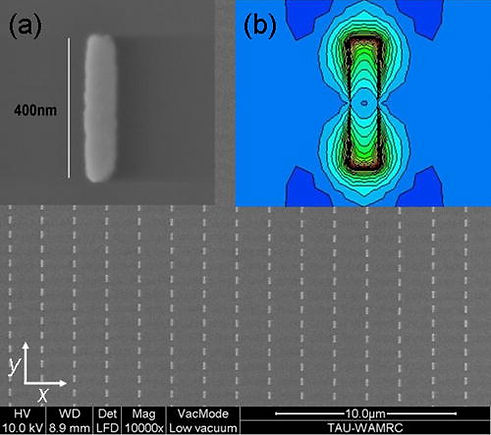
Good sensors require the ability to detect small changes in the properties of the surrounding environment. We use the refractive index (RI) detection technique based on an array of nanometer scale slot-antennas milled in a thin gold layer using a single lithographic step. The high sensitivity and resolution obtained for the slot antenna arrays indicate the attractiveness of plasmonic devices for bio-medical sensing and point out the countless possibilities for further innovation. Future research in this direction involves adapting the slot array structure to different spectral domains and incorporating it into devices that are suitable for medical diagnostics or lab-on-chip frameworks.
Plasmonic Metasurfaces
Subwavelength metallic nanostructures that shape light at will.
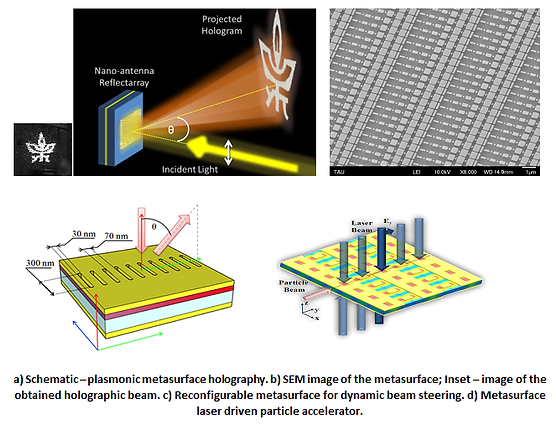
Plasmonic metasurfaces are thin surfaces incorporating many metallic nanostructures of subwavelength dimensions. Such metasurfaces offer the ability to control and manipulate the various properties of light beams (profile, shape, polarization, etc.) almost arbitrarily. This can be achieved by properly designing the shapes of various nanostructures comprising the metasurface to obtain a desired amplitude, phase, and polarization response. Consequently, much research has been focused on plasmonic metasurfaces as a new paradigm and building block for various applications such as flat optics, holography, nano-imaging, beam shaping, and many more.