

Superluminal Lasers for Ultrasensitive Metrology
This is placeholder text. To connect this element to content from your collection, select the element and click Connect to Data.
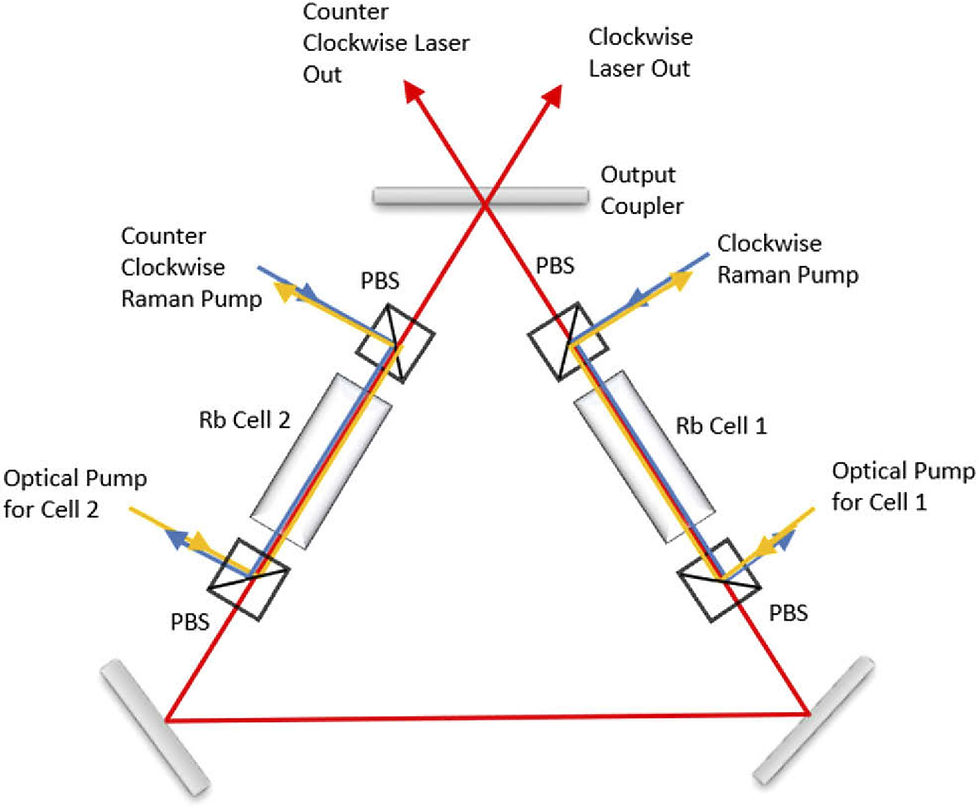
My PhD research focuses on the interaction of coherent light with Rb atoms, aiming to demonstrate an ultrasensitive optical sensor. By placing a vapor cell of Rb atoms inside an optical cavity and applying external lasers, we induce Raman gain and engineer the dispersion relation to achieve group velocity exceeding the speed of light in a vacuum. The cavity and the generated gain form a laser with a unique characteristic known as superluminal lasing.
Research importance:
Superluminal lasers (SLLs) have garnered significant attention over the past decade due to their potential to revolutionize precision measurements and metrology. These lasers operate under conditions where the group velocity exceeds the speed of light in vacuum. In this regime, their spectral sensitivity to variations in ambient parameters is greatly enhanced, potentially improving by six orders of magnitude. This property makes SLLs highly attractive for advanced sensing applications. They are particularly suited for challenging tasks such as gravitational wave detection, dark matter searches, and navigation-grade rotation sensing.